Advantages and Disadvantages of Co-Education: 7 Pros, 5 Cons
The Advantages and Disadvantages of Co Education come down to how well a school manages equity, teaching quality, and safeguarding. Co‑ed environments can strengthen collaboration, reduce stereotypes, and mirror modern workplaces; the trade‑offs, distractions, implicit bias, and safety risks are manageable with clear policies and gender‑responsive pedagogy.
For families in India, Bangladesh and Nepal, weighing the Advantages and Disadvantages of Co-Education means balancing academic outcomes with culture, safety, and long‑term employability. National policies increasingly centre on inclusion, while parents still need practical cues on classroom quality and school culture.
Why this topic matters now
Governments and school leaders are aligning with SDG 4 (quality education) and SDG 5 (gender equality). UNESCO’s 2019–2025 gender-equality strategy treats co-education not as “boys and girls in one room,” but as structures, teaching, and culture that enable equitable participation and outcomes.
In South Asia, families weigh outcomes, social development, safety and employability. India’s NEP 2020 established a Gender Inclusion Fund (GIF) and aligned Samagra Shiksha 2.0 with inclusion goals. Bangladesh’s BANBEIS 2023 compiles official enrollment and institutional data to guide planning and equity. Nepal’s SESP 2022/23–2031/32 emphasises safe, inclusive, and gender-responsive schools.
What is Co-Education? Beyond Just “Mixed-Gender”
Co-education is a system design where girls, boys, and gender-diverse students access the same curricula, teaching quality, leadership opportunities, and safety measures grounded in human-rights commitments, such as CEDAW (Article 10 on the right to education) and the Education 2030 agenda. In practice, it links pedagogy (participation norms and feedback), policy (codes of conduct and reporting) and facilities (sanitation, sports, clubs) to support equitable learning.
Why the legal framing matters: CEDAW obliges states to remove discriminatory barriers and stereotypes in education, translating for schools into expectations for equal participation, unbiased guidance and safe learning for all genders.
7 Key Advantages of Co-Education: Evidence and Impact
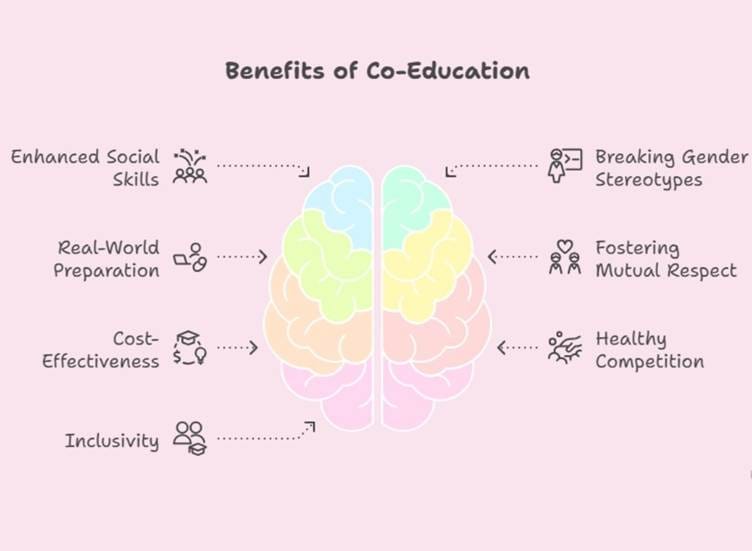
To make a sound choice, you must know both the advantages and disadvantages of co-education. Let’s start with the former first. Below are seven well-evidenced advantages of co-education so you can weigh the pros and make school choices with clarity.
1. Enhanced Social Skills and Communication Competence
In an inclusive pedagogy, students get to learn and play together regularly. This helps them practice communication across genders. Simple classroom practices that pair children with peers of the opposite gender improve cooperative behaviour. It also reduces aggression.
A controlled trial conducted by Arizona State University of the “Buddy Up” intervention found that stronger, more positive peer interactions among preschoolers build empathy. This early co-educational contact also builds practical social skills.
In short, focusing on co-education in every stage of education matters. This is because social competence supports classroom learning. It also smoothens transitions to mixed workplaces.
2. Breaking Gender Stereotypes in Academic/Career Paths
True co-education challenges narrow ideas about what subjects suit boys and girls. When students observe each other succeed in science, technology, art, and other fields, gendered assumptions are weakened. For instance, girls in an inclusive pedagogy setting are more likely to pursue STEM. Thereby, countering prevalent stereotypes seen in many single-sex schools. Similarly, boys get into caring professions.
This shift highlights equal opportunities. It also broadens career horizons for students in Bangladesh. In turn, this helps students prepare for diverse and evolving job markets overseas, especially as industries increasingly value technical expertise alongside foundational general education (read about the contrast between technical and general education).
3. Real-World Preparation and Workforce Readiness
Employers nowadays actively seek interpersonal and collaborative skills in employees. They even expect them to have relevant problem-solving abilities. This shift also redefines how students value hands-on learning alongside conceptual understanding (see how theoretical and practical education complement each other). Classrooms that mix genders give students routine practice of teamwork with diverse peers.
OECD research on a skills-first approach highlights that transferable skills determine labour-market success. That means credentials are not the only important aspects taken into account.
Co-educational settings tend to mirror workplace diversity. They also create safe spaces to build those skills long before graduation. If you desire to study abroad, the flexibility and cooperation skills gained at co-ed institutions will make you ready for an international and multicultural professional environment.
4. Fostering Mutual Respect and Reducing Toxicity
Schools are known for shaping how people think. The odds of gendered bullying reduce as soon as teachers set expectations for respectful interactions in mixed classrooms. It also puts an end to aggressive posturing from becoming normal.
Comparative research and reviews conducted by PubMed show that neither system automatically guarantees better outcomes. However, well-run co-educational schools that teach mutual respect report lower levels of hostile gender stereotyping. Also, there are fewer extreme examples of hypermasculinity.
School culture and leadership, therefore, matter more than simple separation.
5. Cost-Effectiveness and Resource Optimisation
From an economic perspective, co-education presents significant advantages for public education systems. Combining resources for boys and girls into one school reduces infrastructure. It also reduces staffing costs. The funds end up getting used more effectively for educational quality improvements.
Where budgets are tight, co-education helps maximise access and reduce duplication of specialised facilities. That said, governments can use the savings for teacher training and infrastructure. Thereby, ensuring co-educational classrooms remain safe and supportive.
6. Healthy Competition and Motivation
Balanced cohorts can foster encouragement. How? By exposing students to a broader range of learning styles and role models. Meta-analyses comparing single-sex and co-educational schools discover no consistent academic advantage for either model. However, they do show that the classroom climate and teaching methods forecast outcomes.
In many co-educational schools, students benefit from healthy comparison with peers who bring different strengths. That variety can push learners to broaden their efforts and ambition.
7. Inclusivity for Non-Binary and Transgender Students
Single-sex systems often rely on fixed categories that exclude or marginalise transgender and non-binary pupils. Co-education provides greater flexibility for schools to adopt inclusive policies. They even adjust uniforms and design safe facilities for all students.
Bangladesh’s civil society and education programmes are progressively including transgender learners in mainstream settings.
Schools that have clear rules to protect students and include everyone make the school a safer place for students of all genders.
5 Challenges of Co-Education: Solutions for Parents and Educators
Now that mixed-gender education benefits are clear, know that no system is without difficulties. Thankfully, there are ways to address these challenges in logical ways. Let’s take a look at those below:
1. Potential for Distraction and Romantic Dynamics
Adolescence naturally brings curiosity and attention. In mixed classrooms, this can sometimes distract from lessons. Or, perhaps, cause parents to worry about early romantic involvement. Research across South Asia shows that unsupervised socialisation can create tension when cultural norms discourage open discussion of relationships.
The solution is not separate but structured. Group work protocols that assign clear roles help in keeping attention on the running. Similarly, regular teacher oversight and emphasis on respect help in keeping distractions at bay.
2. Persistent Gender Biases in Classroom Dynamics
Even in inclusive schools, teachers may unconsciously give more attention to one gender. Boys, for instance, are often called on more in science and mathematics lessons. At the same time, girls are praised more for neatness and behaviour.
These subtle biases shape confidence and subject choice over time.
Teacher training is the most practical fix. Workshops that highlight common patterns and peer feedback can help teachers reflect on their practice, reducing gender bias to a huge extent.
Nowadays, many holistic education programmes in Bangladesh already include gender sensitivity modules in professional development. Thereby, showing a feasible way forward.
3. Social Anxiety and Communication Gaps
In rural or conservative communities, some children find it intimidating to speak freely with classmates of the opposite gender. This anxiety can limit participation and slow learning.
Students initially hesitate to work in mixed groups. However, a gradual approach works best. For example, start with only same-gender groups doing activities. Then, mix the teams slowly. This allows pupils to adapt at a comfortable pace. Parents can reinforce this progress at home, encouraging open, respectful conversations between siblings or neighbours of different genders. The goal is not forced interaction but steady confidence building.
4. Safety Concerns: Bullying/Harassment Risks
Concerns about harassment are often at the centre of parental hesitation. UNICEF research shows that girls in South Asia, including Bangladesh, still report significant experience of bullying and safety fears on the way to or inside schools.
Addressing this concern mandates a zero-tolerance stance. Clear codes of conduct and accessible reporting channels help create a safer culture. Similarly, immediate consequences for harassment are critical to stop it at the root.
Schools that train both teachers and students in recognising inappropriate behaviour report stronger protection for girls. Parents also play a part by remaining informed and involved. That is how they can support children to speak up when boundaries are crossed.
5. Resource Limitations for Gender-Specific Needs
A final challenge lies in meeting the diverse needs of both genders with limited resources. Clubs, sports and extracurricular programmes sometimes tilt towards one gender. This, in turn, leaves others undeserved. For instance, cricket and football dominate the school budget. However, girls’ sports may receive less attention.
One of the practical solutions for gender bias in classrooms is rotational funding. This means schools should allocate resources on a rotating basis to different clubs and activities. This ensures every student notices their interest represented. Additionally, partnerships with local community organisations can provide facilities or coaching where schools cannot meet all needs alone.
Co-Education Vs. Single-Sex: A Research-Backed Comparison
In the debate between co-ed vs single-sex academic performance, evidence offers a mixed picture. No model shows overwhelming superiority in all areas. Below is a synthesis of academic, social-emotional and cultural findings from recent comparative research.
Academic Performance
Studies done by NSW show that when researchers control for socio-economic status (SES), differences in academic outcomes between single-sex and co-ed schools shrink notably. An analysis of NAPLAN results (reading and numeracy) for co-ed vs single-sex public schools in NSW found that single-sex schools have higher absolute performance. However, once the student background was fine-tuned along with SES, the advantage was modest.
Likewise, a systematic review (Single-sex versus co-educational schooling, AIR, 2021) discovered that academic gains ascribed to single-sex settings often vanished once student background and previous achievement were controlled for.
Social-Emotional Growth
Evidence advocates that co-educational settings tend to foster stronger emotional intelligence. They equip students with better interpersonal skills and comfort in mixed-gender interactions. Students in co-ed often report greater ability in communicating across gender boundaries. They also become capable of working collaboratively.
In contrast, some studies point out that single-sex schools can offer short-term boosts in confidence. This is especially true for girls who might feel freer from gender stereotyping in those environments.
This Monash University research shows that Australian female students in same-sex schools showed higher STEM efficiency. However, large-scale analysis indicates that this advantage often diminishes once factors like school quality and prior academic achievement are controlled. This means that even co-educational Australian students perform at similar levels in STEM pathways.
Cultural Fit
Culture plays a large role in how co-education is accepted and how effective it becomes. Urban families and schools tend to adapt more easily to co-educational models. This is because of their greater exposure to more liberal attitudes.
Rural or more conservative communities may exhibit discomfort during the initial stage. This is particularly true in terms of interactions between genders, dress codes, or teacher-student relationships. Evidence from comparative schooling studies suggests that in some rural settings, students may initially feel less at ease speaking up or participating fully in co-ed classes.
India, Bangladesh & Nepal: policy signals to know
- India (NEP 2020): Gender Inclusion Fund for girls and transgender students; Samagra Shiksha 2.0 provisions for safe sanitation, transport, KGBVs, and teacher sensitisation. Utilise these levers to fund gender-responsive pedagogy and safeguarding in co-educational schools.
- Bangladesh: BANBEIS 2023 is the official national statistics compendium; it informs planning for equitable co‑ed provision at the district/upazila level.
- Nepal: The School Education Sector Plan 2022/23–2031/32 prioritises safe, inclusive, gender‑responsive schooling and is backed by joint financing with development partners.
Optimising co‑ed classrooms: evidence‑based playbook
| Focus area | Best practices | Why it works |
| Teacher training | Run gender‑responsive pedagogy cycles (micro‑audits of talk time; observation rubrics; feedback loops). | Reduces unconscious bias; equalizes participation; improves questioning quality. |
| Curriculum design | Spotlight women in STEM and men in care/education; embed stereotype‑busting capsules in science/humanities. | Reduces unconscious bias; equalises participation; improves questioning quality. |
| Peer pairing & grouping | Structured, rotating mixed‑gender roles (recorder, explainer, challenger). | Builds empathy and collaboration; curbs off‑task behaviour. |
| Safeguarding | Publish student‑friendly reporting flow; annual SRGBV drills; anonymous “concern box”; parent sign‑offs. | Deters harassment; increases reporting; aligns with UNICEF/UNESCO guidance. |
| Family engagement | Workshops on digital safety & respectful online/offline norms; include fathers as allies. | Aligns home/school messages; reduces backlash; sustains culture change. |
Quick comparison: advantages and disadvantages of co‑education
Advantages
- Every day collaboration skills and broader peer role models.
- Stereotype‑challenging environments across subjects and activities.
- Potential system‑level efficiency (reduced duplication; more funds for quality).
- Better fit for gender‑diverse learners under inclusive policies.
Disadvantages/risks (if unmanaged)
- Potential distraction and peer pressure during adolescence.
- Unequal teacher attention or “gendered” feedback patterns.
- Safety concerns (bullying/harassment) without clear protocols.
Bottom line: With strong leadership, gender-responsive pedagogy, and SRGBV safeguards, co-education can deliver equivalent academic outcomes to single-sex schools while better preparing students for mixed workplaces and civic life.
How to choose (for parents in India, Bangladesh & Nepal)
- Check culture & safety first: Ask to see the school’s code of conduct, reporting channels, and staff training on SRGBV.
- Scan classroom practice: Observe who speaks, who is called on, and how feedback is given. Look for structured group roles and balanced talk time.
- Review subject breadth: Confirm access to advanced STEM and arts for all genders; ask about role‑model programs and clubs.
- Ask about inclusion supports: For gender‑diverse learners, request written policies on uniforms, facilities, pronouns and counselling.

Frequently Asked Questions
Do co‑ed schools reduce gender stereotypes?
Often, yes, when teachers actively manage participation and curricula include diverse role models, co‑ed settings weaken rigid subject stereotypes.
Are single‑sex schools better for girls in STEM?
Sometimes, for enrolment patterns (Monash 2018), but those advantages often shrink when prior attainment and school quality are controlled (Monash 2024). Co‑ed schools can match outcomes with targeted pedagogy and guidance.
How do co‑ed schools handle romantic distractions?
Use structured group roles, short cycles and clear norms. Pairing routines like Buddy Up helps keep focus on the task and build healthier peer interactions.
Can co‑education improve workforce readiness?
Yes. Co‑ed classrooms mirror diverse teams and let students practice the soft skills highlighted in skills‑first hiring models.
Do co‑ed schools accommodate LGBTQ+ students?
They can if policies are explicit (uniforms, facilities, pronoun use, reporting). Bangladesh’s third‑gender recognition and India’s GIF provide national levers, but implementation at the school level is essential.
Is co‑education cheaper than single‑sex?
At the system level, combining resources can reduce duplication; savings should fund teacher development and safety. Finance briefs emphasise efficiency and adequacy rather than school type per se.
How prevalent is co‑education globally?
Comparative, cross-country data on single-sex enrollment are scarce, but the GEM ecosystem focuses on inclusive, gender-transformative systems, within which co-education is common in public provision.
Conclusion: Co-Education as a Catalyst for an Equitable Future
When schools put safety, equity, and effective teaching at the centre, co‑education delivers the daily collaboration, communication, and respect students need for life and work. The Advantages and Disadvantages of Co-Education are not fixed traits of a school type, but rather the result of leadership choices, including clear behavioural codes, gender-responsive pedagogy, inclusive facilities, balanced participation, and transparent growth metrics.
For parents in India, Bangladesh and neighbouring countries, the smart move is to judge schools on culture and practice, not labels. Ask about SRGBV policies and reporting, observe who speaks and who gets feedback in class, and review learning growth over time. If these pillars are strong, co-ed schools typically match single-sex settings in academics while better preparing students for mixed teams, diverse workplaces, and civic life.