
What Does Distinction Mean in Grades (Definition & Guide)
When you seek answer to the query ‘What does distinction mean in grades?’, you need to keep in mind a crucial fact about ‘distinction’ – it is not a universal term with a fixed meaning. It varies significantly by country, institution and qualification level.
In academic terms, a ‘distinction’ is a high-performance label signalling outstanding work. However, its exact meaning shifts depending on the context. For instance, it can be a grade band on a transcript. It could mean an overall award classification. It could also define a specific achievement label.
Understanding what distinction mean in grades involves getting familiar with a few fundamental concepts. These include the grading scale that’s applied, the grade boundaries that separate different categories, the rubrics or descriptors that explain what’s expected, how it appears on your official transcript, the policies of the awarding body, and the specific rules laid out in your course or unit outline. This guide will help you navigate these variables.
Distinction in Grades: What does Distinction Mean in Grades in Plain Language
Put simply, a distinction is a top-tier academic grade. It appears on your transcript or award certificate to indicate that your work has exceeded the standard pass requirements and demonstrated high-quality understanding and skill. The key constraint is that its definition varies by educational system. You cannot rely on a universal percentage; you must check the official grade descriptors and awarding-body specifications for your specific programme.
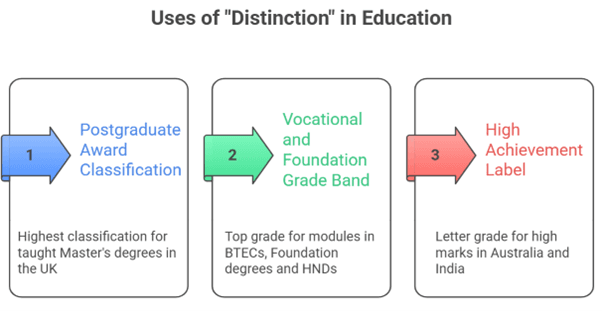
The 3 Most Common Uses of “Distinction”
1. Postgraduate Award Classification
In the UK, for taught Master’s degrees (MA, MSc), “Distinction” is the highest overall classification, typically for a final average of 70% and above.
2. Vocational and Foundation Grade Band
For qualifications like BTECs, Higher National Diplomas (HNDs) and Foundation Degrees, “Distinction” is the top grade for individual modules or units, often based on criterion-based achievement and not just a percentage, as shown in Pearson’s official BTEC assessment and grading guidance.
3. High Achievement Label in Percentage Systems
In countries such as Australia and India, “Distinction” or “High Distinction” is a letter grade or division delivered for gaining marks that surpasses a set percentage threshold (for example 75% or 85%).
What “Distinction” Does Not Guarantee (Avoid Common Myths)
- It does not ensure employment or postgraduate acceptance. While impressive, employers and universities consider your whole profile.
- It does not have a fixed global percentage equivalent. A 70% distinction in the UK represents a different standard to a 75% distinction in Australia, which is why it helps to understand how grading scales differ internationally.
- It may not be awarded if you fail to attain specific requirements, such as a minimum dissertation mark, even if your overall average is high.
Distinction Grade Boundaries by System (Typical Ranges + How to Verify)
The following table outlines how “distinction” is typically applied across different systems. Always verify the exact boundaries with your own institution.
| System/Region | Label Set | Typical Range | Where It Appears | What to Check |
| UK Postgraduate | Distinction, Merit, Pass | 70% and above | Final degree certificate & transcript. | Programme handbook for specific rules (e.g., dissertation minimums). |
| UK Undergraduate | First, 2-1, 2-2, Third | Not usually called “distinction.” First-Class Honours = 70%+. | Final degree classification. | University’s academic regulations for weighting of each year. |
| Australia / NZ | High Distinction (HD), Distinction (D), Credit, Pass | Distinction (D)- 75-84%; HD- 85-100%. | Individual unit results and transcript. | Course outline for each subject, as boundaries can vary by state/university. |
| South Asia | Distinction, First Division, etc. | Often 75%+ (can vary). | Marksheet or final transcript. | University ordinances or academic code for official division/class criteria. |
| Vocational (e.g., BTEC, HND) | Distinction, Merit, Pass | Criterion-based; often aligns with ~70%+ equivalent. | Unit results and overall qualification certificate. | Awarding body specification (e.g., Pearson for BTEC) and unit grading criteria. |
UK Universities: Master’s Distinction vs Undergraduate Classifications
In the UK, “Distinction” is primarily a postgraduate label. For a taught Master’s degree, you need a final weighted average of 70% or higher, which is directly comparable to an undergraduate First-Class Honours. Undergraduate degrees themselves are not classified as “Distinction”; they use the honours system (First, 2-1, etc.).
Australia/NZ: High Distinction / Distinction / Credit / Pass Labels
The Australian system uses Australian grading bands in a banded structure. “Distinction” (D) is a high grade, but it sits below the top tier of High Distinction (HD). Achieving a D typically requires a score between 75% and 84%. Always check your university’s policy, as shown in published official grading system tables.
South Asia: “Distinction” as Division/Class (Percentage-Based)
In systems like India’s, “Distinction” is often an overall award classification based on your final aggregate percentage, reflecting percentage-based divisions in South Asia. The threshold is commonly 75% or higher, but this can vary significantly between universities and states.
Vocational Awarding Bodies: Pass/Merit/Distinction (Criteria-Based)
In the case of vocational qualifications like BTECs, grades are given based on how well you fulfil the specific learning criteria set out in the unit specification, rather than just your test results. Achieving all criteria at the highest standard earns a Distinction, and awarding bodies also publish how overall qualification grades are calculated.

Distinction vs Merit vs Pass vs Honours (What’s Higher and What’s Comparable)
Besides getting familiar with what does distinction mean in grades, Understanding the hierarchy of these terms is crucial for interpreting your results.
| Label | Rank | Meaning | Common Contexts | Not the Same As |
| Distinction | Highest | Exceptional, outstanding performance. | UK Master’s, Aus/NZ grades, Vocational quals. | UK undergraduate First (but equivalent standard). |
| Merit | Middle | Strong, above-average performance. | UK Master’s, Vocational quals, some Ordinary degrees. | UK undergraduate 2-1 (but often comparable). |
| Pass | Base | Satisfactory meeting of all learning outcomes. | All systems (minimum threshold to qualify). | A low grade; it signifies competency. |
| Honours (First) | Highest (UG) | Highest undergraduate classification (70%+). | UK Bachelor’s degrees. | A Master’s Distinction (different level of study). |
Quick Ranking in Banded Systems (Pass < Merit < Distinction)
In systems that use all three terms (like UK Master’s or BTECs), the hierarchy is straightforward. For instance, Pass is the baseline, Merit is above that, and Distinction is the top grade.
Is Distinction the Same as an A or 4.0 GPA? (Careful Answer)
A UK Master’s Distinction or an undergraduate First is quite similar to US ‘A’ or a 4.0 GPA, indicating top-notch performance. However, direct conversion is risky because marking cultures differ. Never self-convert on an application; let the receiving institution evaluate your transcript.
Distinction vs Honours/First-Class- When Terms Don’t Match
Confusion arises because a UK Master’s Distinction is comparable in standard to a UK undergraduate First-Class Honours – they both typically start at 70%. They are equivalent in achievement level but apply to different qualification levels. “Honours” can also refer to a type of bachelor’s degree programme, which is a separate concept altogether.
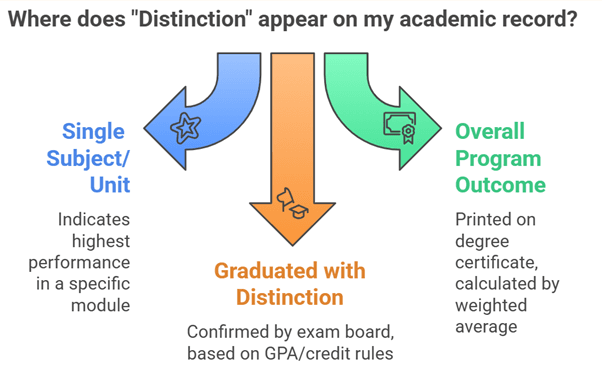
Where “Distinction” Appears on Results (Course, Program, or Graduation Award)
It’s vital to distinguish where you see “distinction” to understand what it means.
- In a Single Subject/Unit: On your transcript for a specific module. It means your work in that unit met the highest rubric-level performance criteria.
- As an Overall Program Outcome: Printed on your final degree certificate (e.g., “MSc awarded with Distinction”). This is calculated employing a weighted average of all your modules, often with specific rules.
“Graduated with Distinction”: This phrase generally relates to the overall program award. It is governed by strict GPA or credit rules and is confirmed by an exam board at the end of your studies.
Checklist: Which type of distinction is this?
- Is it on a detailed transcript next to a single module/course code? → Unit-level grade.
- Is it on your final degree/diploma certificate? → Overall award classification.
- Does your official transcript come with a legend or key explaining the grade abbreviations? → Inspect first for the official definition.
How to Find Your School’s Definition of “Distinction” Fast (5-Minute Method)
1. Locate the Official Rule.
Go to your university’s website. Navigate to Current Students > Academic Regulations or Quality Manual. Find your specific programme handbook for the year you started.
2. Verification Checklist:
- Document: Programme Specification or Assessment Regulations.
- Year: Ensure it is for your cohort year as the rules can get modified.
- Program Code: Locate your exact course code (for instance, ABC123).
- Section: Search for “Award,” “Classification,” or “Grading.”
3. Email Template to Ask Registry/Course Coordinator:
Subject: Query regarding [Your Programme Code] distinction criteria
Dear [Name],
I am a student on the [Programme Name]. Could you please direct me to the official document that outlines the percentage boundaries and any additional requirements (e.g., for dissertation) for achieving a Distinction classification?
Thank you,
[Your Name], [Student ID]

How to Aim for a Distinction (Rubric-Aligned, Practical Strategies)
Success hinges on aligning your work with the published marking criteria.
What “Distinction-Level Work” Usually Looks Like
Markers really value work that showcases critical thinking, original ideas, and the ability to weave together complex concepts. They admire individuals who go beyond simple descriptions to reveal a profound understanding and a unique engagement with the material.
Strategies by Assessment Type
- Essay/Report: Make sure to closely align each section with the grade descriptors. Use top-notch, up-to-date sources and provide a critique rather than just listing them. It’s important to create a clear narrative that drives your arguments throughout your work.
- Exam: Practice tackling past papers while timing yourself. Pay special attention to application and analysis questions, instead of memorising facts. When you respond, structure your answers with well-defined arguments to enhance clarity.
- Project/Dissertation: Start early. Design a robust methodology. As you discuss your findings, be critical and acknowledge any limitations while also suggesting directions for future research. Seek regular feedback from your supervisor.
Distinction QA Checklist Before Submission
- Have I thoroughly tackled all elements of the assignment question and the learning outcomes?
- Does my work demonstrate critical evaluation/analysis rather than just description?
- Is my argument logical, supported by high-quality evidence, and does it engage with different perspectives?
- Have I made sure to thoroughly proofread for clarity, structure, and technical accuracy, like referencing as well as grammar?
If You Need to “Translate” Distinction for Applications
| Do/Avoid | Example Phrasing |
| Do- List the award as-is on your CV with context. | “MA in History, University of Example – Awarded with Distinction (highest classification, top 10% of cohort).” |
| Avoid- Self-converting to a GPA or letter grade. | Don’t write- “MA – Equivalent to a 4.0 GPA.” |
| Do- Use the transcript legend for official explanations. | Provide the official key from your transcript if needed. |
| Avoid- Assuming global equivalence. | Don’t claim a UK Distinction equals an Australian HD without evidence. |
| Do- Use official credential evaluation services when required. | For complex applications (e.g., US jobs), use services like UK ENIC or a NACES member. |
How to Write “Distinction” on a CV or Application (With Context)
Always state the full award title and the classification. Adding brief context (“highest attainable grade”) is helpful for international readers.
Why GPA/Letter-Grade Conversions Are Risky (What Varies)
Marking scales, grade distribution and academic culture differ globally. A 70% in the UK is exceptional. Whereas in other systems it might be average. Official conversion is the role of admissions or HR professionals, not applicants.
When to Use Official Credential Evaluation Guidance (Jurisdiction Cue)
Use a professional credential evaluation service (like ECCTIS in the UK or WES in the US/Canada) when applying for jobs, further study, or professional licensing in a country with a very different education system. They provide an authoritative equivalency statement.

Frequently Asked Questions
Is distinction higher than merit?
Yes. In systems that use both terms (like the UK Master’s), Distinction is the highest grade, followed by Merit, then Pass.
What percentage is usually a distinction grade?
It varies. Commonly 70%+ in UK postgraduate, 75%+ in Australia, and 75%+ in South Asian systems. Always verify with your institution.
Is a distinction an A grade?
It is broadly comparable to an ‘A’ or the top of a grading scale, signifying excellent work. However, they are different labels from different systems. That’s why direct equivalence should not be assumed.
What does “graduated with distinction” mean?
This typically means you received the highest overall classification for your programme (e.g., a Master’s degree was awarded with Distinction).
Can you still obtain a Distinction after a resit/retake?
Often, no. A lot of universities limit resit marks to the minimum passing score (for example, 40% or 50%) to ensure fairness. This makes it really tough, if not impossible, to reach a Distinction average if you have to take resits.
How do I calculate what I need for an overall distinction?
You need your university’s specific weighting formula. Typically, final-year modules are weighted most heavily. Use a weighted average calculator, inputting your current marks and the credit values, to see what you need in remaining assessments.
How should I present distinction for international applications?
Present it accurately as awarded. On forms, select “Other” for grade and write “Distinction” if it is not listed. In personal statements, you can briefly note it’s the highest classification. Provide official transcripts and let the institution assess equivalency.
Conclusion
A distinction is a significant academic achievement marking high-quality performance. Its meaning, however, is defined by your specific educational system, institution and official regulations.
Your path forward to “what does distinction mean in grades” is clear. First, check your programme handbook & grading policy to confirm the exact boundaries and weighting rules. Then, use the rubrics and marking criteria as your roadmap for targeting distinction-level work in every assessment. Good luck!