
Easiest Medical Schools to Get Into UK: UCAT Fit Guide
Applying to medical school in the UK is extremely competitive. Every year, thousands of strong students apply, yet only a small percentage receive offers. It is no surprise that many applicants start searching for the easiest medical schools to get into UK. However, here is the reality: there is no single “easy” medical school. What feels easier depends on your grades, UCAT score, GCSE profile and interview performance.
We will group the UK medical schools by selection style and list examples under each group.
What does “easiest medical schools to get into UK” mean?
Easiest does not mean lower standards. All UK medical schools must meet General Medical Council standards, and competition is high across the board. In practice, “easier” means that a school’s selection process aligns better with your profile.
Medical schools differ in how they score:
- A level grade (minimum vs typical offers, including how A levels compare to IB)
- GCSE performance and subject requirements
- UCAT thresholds or weightings
- Contextual indicators
- Interview performance, often via Multiple Mini Interviews (MMIs)
For example, a candidate with strong GCSEs but an average UCAT may find a GCSE-weighted school easier than one that uses a strict UCAT cut-off. An applicant eligible for contextual consideration may receive adjusted thresholds that significantly change competitiveness.
The safest approach is to stop searching for rankings and instead search for fit. If you also want context beyond medicine, see wider UK university options.

How UK medical schools shortlist applicants?
Before building your four UCAS choices, assess each programme using five screening factors. These determine whether a school is realistically aligned with your stats.
1. Minimum A-level and GCSE rules
Do you meet the published minimums, including required subjects and GCSE counts? Meeting minimum qualifications does not guarantee an interview.
2. UCAT use type
Does the school apply a hard cut-off before the interview invitations are sent, weigh UCAT alongside grades, or use it post-interview?
3. Shortlisting method
Is the school GCSE-heavy, UCAT-heavy, or mixed? Your strengths should align with their scoring emphasis.
4. Contextual and widening participation routes
Do you qualify for contextual offers or gateway/foundation pathways?
5. Places and applicant competition
Some programmes offer fewer places or have high application-to-interview ratios.
Now, let us apply these factors to real UK medical schools grouped by the selection model.
What is considered a low UCAT score?
A low UCAT score is best defined relative to the current test cohort, not by a fixed number. The UCAT Consortium publishes deciles (percentiles) each cycle so candidates can interpret where their score sits in the distribution.
For the 2025 UCAT test cycle, the final mean total cognitive score was 1891 (with three cognitive subtests: Verbal Reasoning, Decision Making, Quantitative Reasoning).
UCAT also reports Situational Judgement Test (SJT) band distribution (Band 1-4), which some universities use as an extra screen.
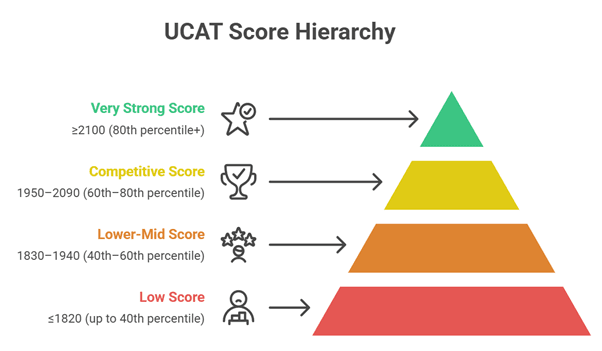
UCAT score bands based on 2025 deciles (use this to label your score)
| Band (2025) | Total score guide | What it means (practical) | Overseas applicant approach |
| Low | ≤1820 (up to 40th percentile) | Below average compared to cohort | Prefer schools that use UCAT post-interview/lightly or mixed models; avoid UCAT cut-off heavy choices |
| Lower-mid | 1830–1940 (40th–60th percentile) | Around average | Mixed-model schools may be viable if grades/GCSEs are strong; avoid building a UCAS set entirely around UCAT filtering |
| Competitive | 1950–2090 (60th–80th percentile) | Strong | A wider set of options; still verify each programme’s UCAT use type for the current cycle |
| Very strong | ≥2100 (80th percentile+) | Top cohort range | Broadest flexibility; focus shifts to interview fit and programme constraints |

Best UK Medical Schools for Low UCAT Scores
If your UCAT sits in the lower or lower-mid band relative to the current deciles, your strategy should shift from which schools accept low UCAT to which selection model reduces UCAT risk.
Searching for the best medical schools for low UCAT can be risky if it turns into chasing last year’s cut-offs. UCAT thresholds shift annually based on applicant performance and cohort size. A safer method is to shortlist by how UCAT is used by universities, not by a single historical score.
Broadly, UK medical schools fall into three UCAT use styles:
1. Hard cut-off before the interview
These programmes set a numerical UCAT threshold each cycle. Applicants below that score are not invited to interview, regardless of grades. If your UCAT is lower relative to national performance, these schools are higher risk. This makes them feel more difficult for candidates with lower-than-average UCAT scores, despite the grades appearing high. The point of this model is simple: in case your UCAT fails to clear the line on that cycle, you won’t be likely to be interviewed, no matter how good the rest of your application might be.
Here are some institutions that have a clear UCAT threshold.
1. University of Bristol (MB ChB A100)
It directly mentions that the sum of the UCAT cognitive score (without SJT) is used to shortlist applicants to interview. They even publish the recent thresholds (which may vary on an annual basis).
2. University of Sheffield (MBChB A100)
This institution outlines the staged process and is quite clear that there is a threshold of minimum UCAT score in addition to academic requirements.
3. Newcastle University (A100)
It confirms that there is a UCAT threshold, and it may vary each cycle based on the applicant scores. So it is better to check the site for the most recent details.
These were the higher UCAT-dependence schools. You can apply them as higher-risk alternatives when UCAT is in a lower band.
2. Weighted alongside academics
Here, UCAT is not given separate consideration. It is considered alongside GCSE grades and predicted A-levels to derive a total score. A moderate UCAT can be balanced by strong GCSE performance or academic strength. For many students, this method seems more lenient than schools that have a hard UCAT cut-off.
Here are some choices in this category.
1. University of Leicester (MBChB)
Its website indicates that it bases its scoring on academic qualifications and UCAT in selecting to interview. It also cites a scoring document which describes the framework.
2. University of Nottingham
The university says that, provided that you meet entry requirements, it will utilise UCAT scores to choose (and make additional nuances to applicants without GCSEs or those submitting with a degree).
3. Queen University Belfast (A100)
On their website, you will see that they explicitly indicate that the GCSE performance score (best 9 subjects) and UCAT score are used in conjunction with the GCSE score to be ranked in the interview.
These are balanced scoring schools. It is likely to favour applicants who are GCSE-strong, UCAT-strong or balanced.
3. Used lightly or post-interview
Some medical schools do not rank applicants heavily by their UCAT score. Instead, they use it simply to make sure candidates meet a basic standard. After that point, other factors such as academic results and interview performance can play a bigger role in the final decision.
Historically, schools such as the following have used selection models that may reduce UCAT risk (always verify current cycle policies):
1. Cardiff University (Medicine MBBCh)
According to the Cardiff University website, it has no minimum UCAT requirement, and its admissions policy says that a UCAT cut-off requirement can only be implemented once there are too many applicants who have the top academic results.
2. Keele University (MBChB)
It clearly states that UCAT combines with personal statement marks for interview selection. If you need help shaping your narrative, see guidance on writing a strong statement of purpose. This approach is more flexible/holistic in use than the rigid cut-offs in most cycles.
3. University of Sunderland (MBChB)
It outlines the process of shortlisting according to academic requirements, its interview selection tool, and UCAT and observes that applicants that pass the minimum requirements may receive an online form during the process.
These are often considered some of the easiest medical schools to get into UK.
Shortlisting safely with a lower UCAT
If your UCAT is below average:
- Prioritise schools that use weighted models, not strict cut-offs
- Avoid applying to four schools that all use high cut-offs
- Check whether contextual criteria adjust UCAT thresholds
- Verify current cycle wording on official admissions pages
A low UCAT does not automatically remove your chances. It changes where to apply with low UCAT UK.
Contextual Offers and Foundation Year Medicine UK – Gateway Routes that Change Competitiveness
For some students, the idea of “easiest” can look very different once contextual or gateway routes are taken into account. Many UK medical schools recognise that not everyone has the same background or opportunities. Because of this, some universities adjust their entry requirements for eligible applicants.
Contextual offers medicine UK are usually available to students who meet widening participation criteria. This can include:
- Attending a lower-performing school
- Living in a postcode flagged for university measures
- Having been eligible for free school meals
- Being care-experienced
The exact rules depend on the university, and each school has its own way of assessing eligibility.

Graduate Entry Medicine vs Undergraduate Medicine (Is GEM easier to get into?)
Graduate Entry Medicine UK (GEM) is sometimes described as easier for applicants who already hold a degree. In reality, it is not easier overall; it differs in structured and competition dynamics.
GEM programmes are shorter, usually four years, and require a completed undergraduate degree, often with a minimum classification such as a 2:1. Some programmes require specific science backgrounds; others accept a wider range of degrees. Admissions tests may include the UCAT or other assessments, depending on the programme.
The key difference is the number of places available. GEM courses typically offer far fewer seats than standard undergraduate medicine. As a result, competition ratios can be high. However, for applicants with strong academic records, relevant healthcare experience, and clear motivation, GEM can align better than reapplying through undergraduate entry.
Undergraduate vs GEM comparison
| Factor | Undergraduate Medicine | Graduate Entry Medicine |
| Typical length | 5–6 years | 4 years |
| Entry requirement | A levels | Completed degree (often 2:1+) |
| Places available | Higher | Fewer |
| Admissions tests | UCAT (most schools) | UCAT or programme-specific test |
| Suits | School leavers | Degree holders with clear direction |
Easier depends entirely on your academic background and competitiveness within the applicant pool.
How to build a balanced UK medical school shortlist – Quick rubric
Through UCAS, you can apply to four medical programmes. The most common mistake is selecting four schools that screen applicants in the same way.
Instead, use the scoring rubric to build a balanced set across selection styles.
Step 1: Score 8-12 programmes
For each programme, score out of 100 using:
- Grades fit (25)
- GCSE fit (15)
- UCAT fit (30)
- Contextual advantage (15)
- Interview format fit (15)
Only include programmes where you meet the minimum subject and grade requirements.
Step 2: Categorise your results
- 75+ = Strong fit
- 60–74 = Realistic
- 45–59 = Higher risk
- Below 45 = Avoid for this cycle
Step 3: Distribute risk intentionally
A balanced UCAS medicine set might include:
- 1 school where your profile is clearly strong
- 1 academically weighted school
- 1 mixed UCAT model school
- 1 moderate-risk option
Avoid selecting four programmes that all depend heavily on a screening factor where your profile is weaker.
How to improve your chances at less competitive UK medical schools
- Meet all minimum academic and subject requirements before applying.
- Verify current admissions policies on the official school website and UCAS.
- Choose programmes aligned with your UCAT profile and academic strengths.
- Prepare structured answers for common MMI themes: motivation, ethics, and teamwork.
- Seek mock interview feedback from teachers or mentors.

Frequently Asked Questions
Which medical school is easiest to get into in the UK?
There is no universally easiest UK medical school. Competitiveness depends on how your grades, GCSE scores, UCAT scores and contextual eligibility align with a school’s selection formula. “Easiest” refers to the best alignment with your academic profile.
Which UK medical schools have the lowest entry requirements for medicine?
Some programmes publish slightly lower minimum grades or contextual offers. However, minimum requirements are not typical offers. Always verify subject requirements, GCSE rules, and resit policies on the current UCAS and UK medical school admissions policy pages.
Where should I apply with a low UCAT score in the UK?
Avoid relying on last year’s cut-offs. Prioritise schools that use UCAT in a weighted or mixed model rather than strict cut-offs. Balance your four UCAS choices across different selection styles to reduce risk.
Are foundation year medicine courses easier to get into?
Foundation or gateway medicine can be less competitive for eligible applicants under the widening participation medicine UK criteria. Eligibility rules are strict and usually limited to home fee status applicants. Always check evidence requirements before applying.
Is graduate entry medicine easier than undergraduate medicine?
Graduate Entry Medicine is not necessarily easier in general. There are usually fewer spots available, and the competition is very tough. If you are thinking longer-term about specialities, it can help to understand what it takes to become a radiologist. It may suit applicants with a strong degree and relevant experience. However, entrance tests and thresholds still apply.
Do international students have easier UK medical school options?
International applicants compete for a limited number of places at each school. Generally, requirements are the same as for home applicants; however, quotas vary. Strategically shortlisting based on UCAT use and academic fit is a must.
What are common UCAS medicine shortlisting mistakes?
Applying to four schools that all screen heavily on one weak area, ignoring subject requirements, relying on outdated cut-offs, and misunderstanding contextual eligibility are common mistakes. Balanced, policy-based shortlisting improves your odds.
To sum up
There is no universal answer to “Which are the easiest medical schools to get into UK”. Instead, each UK medical school uses its own selection model, academic requirements and UCAT approach. This changes the level of competition associated with each applicant.
Some schools may be more challenging for applicants with lower UCAT scores. This is because they apply a firm UCAT threshold before interview. Others combine UCAT scores with GCSEs and A-level results to create a weighted ranking system. A third bucket of universities gives more importance to academic scoring rather than UCAT scores, making it ideal for those with a mid-range UCAT score.
A safe strategy is not to chase rumours or last year’s cut-offs but to verify each programme’s current admissions policy through UCAS and official medical school pages, alongside guidance from the Medical Schools Council.
Next steps:
- shortlist universities strategically,
- apply the scoring rubric,
- check eligibility,
- prepare supporting evidence for medicine and
- Practice for MMIs.
Clever shortlisting changes uncertainty to calculated risk.