
Difference Between a Diploma and a Degree (UK Guide)
A degree usually refers to an accredited higher-education credential such as an associate, bachelor’s, master’s, or doctoral qualification. A diploma is often shorter and more applied, but here’s the catch: “diploma” can mean very different things depending on the country, the institution, and the qualification framework. In some systems, it can be a secondary school credential, in others, it can mean a post-secondary vocational award, and in others, it can mean a postgraduate qualification.
That’s why the smartest way to know the difference between a diploma and a degree is not by the label alone. You want to know three things before you commit: what level it sits at, whether it is recognised/accredited, and what it qualifies you for (jobs, licensing, or further study). Qualification frameworks exist specifically to make these levels easier to compare across systems (for example, the European Qualifications Framework works as a translation tool across countries).
This guide helps you learn, compare and decide. This way, you can take the next step with confidence.
Diploma vs Degree: Key Differences (Comparison Chart)
The most reliable difference between a diploma and degree shows up in credential level, length, academic credits, curriculum breadth, and recognition, not in stereotypes like “diplomas are easy” or “degrees guarantee jobs.” In many education systems, diplomas commonly sit in short-cycle tertiary education (often 1–3 years) and are designed to be practical and employment-oriented, while degrees usually represent longer, more academically structured programs.
Diploma vs Degree (Copy-Ready Matrix)
| Factor | Diploma (typical) | Degree (typical) |
| Credential level | Can range from secondary to postsecondary to postgraduate | Clearly defined higher-ed levels (associate/bachelor’s/master’s/doctorate) |
| Awarded by | Colleges, vocational institutes, training providers, some universities | Colleges, vocational institutes, training providers, and some universities |
| Typical duration | Often 6 months–3 years (varies widely) | Associate 2 years, bachelor’s 3–4 years, master’s 1–2 years (varies by system) |
| Credits (credit hours/ECTS) | Usually fewer credits; may be competency-based | Higher credit volume with structured credit systems |
| Curriculum focus | Applied/job-ready skills; technical or vocational emphasis | Broader academic foundation and specialisation (major) |
| Assessment style | Practical projects, skills assessments, placements | Exams, research, capstone, labs, theory and applied work |
| Work placement | Common in many diploma pathways | Varies by program; common in professional degrees |
| Recognition | Depends heavily on framework level and accreditation | Typically widely recognised when accredited |
| Typical outcomes | Entry roles, upskilling, faster job entry, pathway to higher study (sometimes) | Professional-track roles, graduate study eligibility, broader screening acceptance |
| Pathway options | May transfer to degree via credit transfer/top-up (policy-based) | Progression to higher degrees and professional credentials |
Trust notes (don’t skip this)
- Verify level using national qualification frameworks or equivalency tools (for example, the EQF is built to help compare qualifications across countries).
- Verify recognition/accreditation using official directories (in the U.S., DAPIP lists institutions/programs reported to the Department of Education; CHEA also provides accreditation directories and international QA listings).
- Watch out for “diploma” branding that does not match the actual level (some countries list diplomas at multiple levels).
One-line goal mapping
If your goal is fast job entry, start with a recognised college diploma; if your goal is professional progression, licensure, or graduate school, prioritise a recognised degree (or a diploma that clearly transfers into one), including flexible part-time degree options.

Is a Diploma Equivalent to a Degree? (It Depends on Country and Level)
A common misconception is that a diploma and a degree can be directly compared or treated as equivalent. Globally, they cannot be equated by name alone. Equivalence depends on three verifiable factors: qualification level, accreditation or credential recognition, and the education system in which the credential is awarded.
Why equivalence varies globally
The term “degree” usually refers to a clearly defined higher-education level, such as bachelor’s or master’s. The term diploma, however, is used across multiple levels of education worldwide. In some systems, a diploma is a secondary school exit credential. In others, it is a postsecondary vocational award.
In some cases, it refers to a postgraduate qualification completed after a bachelor’s degree. Because of this variation, asking whether a high school diploma is equivalent to a degree without context leads to incorrect conclusions.
What “diploma” can mean in different systems
| Diploma type | Typical placement (framework-based) |
| Secondary school diploma | Upper secondary education |
| Postsecondary/college diploma | Short-cycle or vocational tertiary |
| Advanced diploma | Upper-level vocational or applied tertiary |
| Postgraduate diploma (PGDip) | Post-bachelor’s, below or alongside master’s |
These placements are not universal rules. They are framework-guided interpretations, and the same title can sit at different levels in different countries.
Using qualification frameworks instead of labels
To compare credentials accurately across borders, countries make use of national qualification frameworks. These frameworks assign levels based on learning outcomes, complexity, and credit volume rather than titles. Regional tools, such as the European Qualifications Framework, act as translation references between systems, but they do not automatically grant equivalence.
Credits and outcomes matter more than the name
A diploma with fewer credits as well as limited academic scope is not equivalent to a degree, even if both are postsecondary, and the same credit logic applies when comparing taught versus research master’s. Conversely, a postgraduate diploma may sit academically close to a master’s level but still differ in credit volume, research requirements, and progression rights.
When equivalence claims fail
Equivalence does not apply when a credential is issued by an unaccredited provider, marketed using local terminology for international appeal, or evaluated without reference to an official framework. Credential evaluation agencies and regulators assess level, credits, and credential recognition, not branding.
Bottom line: A postgraduate diploma is equivalent to a degree only when an official qualification framework or credential evaluation explicitly confirms it. Always verify using framework-level descriptors and recognised accreditation sources for diploma vs degree duration and more, never by title alone.

Diploma vs Degree in Curriculum: Credits, Depth, and What You Actually Study
The most practical difference between a diploma and degree appears in how much you study, how deeply you study, and how learning is structured. Labels alone do not reveal this. Curriculum design, credit volume and assessment methods do.
Credit volume and learning depth
Degrees generally mandate a higher number of academic credits. Also, they are mapped to clearly defined higher-education levels within the UK higher education qualification frameworks. They typically include a combination of general education, discipline-specific courses and advanced study within a major. Diplomas usually carry fewer credits. Also, they focus more narrowly on occupational or technical competencies.
Because credit systems vary globally, credits may be expressed as credit hours (see the federal definition of a credit hour), ECTS, or national equivalents. What really counts isn’t the name of the unit, but whether the total credit volume fits within an established framework level.
Curriculum structure
Degree programs usually emphasise:
- Conceptual understanding and theory
- Progressive learning from foundational to advanced topics
- Independent research, analysis, or synthesis
Diploma programs usually emphasise:
- Practical skills and applied learning
- Direct alignment with specific job roles
- Structured training with defined competencies
Assessment and learning methods
Diplomas often rely on skills-based assessments, practical projects, and supervised placements, and how results are classified can vary, too, including what a distinction usually means. Degrees commonly combine exams, coursework, labs, and, at higher levels, a capstone project or research component. These differences affect how transferable the learning is to further study.
Practicum, capstone and transferability
Work placements or practicums are common in diplomas and some professional degrees. Whereas capstones are more typical in degrees. In fact, they signal higher-level academic integration. Transferability depends on whether credits are recognised by receiving institutions, not on whether learning feels “advanced.”
Program legitimacy and comparability checklist
Before enrolling, verify:
- Total credits and contact hours
- Placement or practicum requirements
- Learning outcomes and assessment methods
- Graduation requirements
- Published transfer or progression policies
- Accreditation or framework alignment
Always confirm details in official program catalogues or handbooks, and if you are applying internationally, also verify key documents, such as what a CAS letter is. Marketing summaries rarely contain the full academic picture.
Jobs and Licensing: Which Employers Accept a Diploma vs Degree?
When students ask whether a diploma course vs degree course is “better for jobs,” the correct answer is it depends on the role, sector, and regulatory environment.
Employer hiring patterns
Most of the entry-level jobs and skills-based jobs accept diplomas, especially in a job performance based on applied competencies. Degrees are more commonly needed for roles involving professional progression, leadership tracks, or analytical responsibilities. Large employers may also employ automated screening systems that filter by credential level, which can disadvantage advanced diploma holders in certain contexts.
Regulated vs non-regulated careers
For regulated professions, employer preference does not decide eligibility. What really counts is whether the credential aligns with the requirements set by the relevant licensing authority or regulatory body. In these cases, a diploma may be insufficient even if employers value experience. This is because licensure rules override hiring discretion.
For non-regulated roles, employers might prioritise demonstrated skills, portfolios & experience over credential type. This is especially common in technical or creative fields.
Common requirement patterns by field
| Field | Typical entry credential | When a degree is required | Licensing notes |
| Healthcare | Diploma or degree | Often required for progression | Regulator-defined |
| Engineering/Construction | Diploma for technician roles | Degree for professional roles | Jurisdiction-specific |
| IT | Diploma or degree | Often role-dependent | Usually unregulated |
| Business | Diploma or degree | Degree for management tracks | Employer-driven |
| Education | Degree | Commonly mandatory | Regulated |
| Creative fields | Diploma or degree | Portfolio often decisive | Usually unregulated |
How to verify job eligibility (5 steps)
- Identify your target role and region
- Check out various job listings to understand the credential requirements
- Examine licensing requirements or regulatory rules, if applicable
- Confirm program accreditation or framework level
- Verify progression options for future advancement
Critical caution
Employers may accept a diploma for entry but still require a degree for promotion, mobility, or international recognition, and if you are planning a UK route, it also helps to understand accepted study gap rules in the UK. Always evaluate long-term career pathways, not only your first job’s eligibility.

Which Should You Choose? (Decision Checklist and Diploma-to-Degree Pathways)
Choosing between a diploma course vs a degree course is not about which credential sounds better. It is about aligning it with your goal, recognition, time, cost as well as future progression options. A structured decision process helps you avert costly detours.
Step 1: Start with your primary goal
Be clear about what you want next, and not just now.
- Fast job entry or skill upgrade: a recognised diploma may be sufficient
- Career advancement, leadership, or mobility: an associate degree is often safer
- Regulated profession: follow the licensing body’s required credentials
- Graduate or postgraduate study: a degree is usually required
If your goal requires licensure or further study, always verify eligibility first.
Step 2: Check recognition and level
Confirm where the credential sits in the national qualification framework, and consider the institutional context too, including how public and private universities differ. Also, check whether the institution as well as the program are formally recognised. Do not rely on marketing terms such as “industry-ready” or “globally accepted.”
Step 3: Compare time and total cost
Diplomas are usually shorter and may cost less upfront. Degrees take longer. However, they may unlock broader opportunities. So, compare total cost to completion. This includes the risk of needing additional study later.
Step 4: Evaluate progression and flexibility
Many learners start with a diploma and then make a move to an associate degree through:
- Credit transfer
- Top-up or bridging programs
- Recognition of prior learning (RPL/PLA)
These pathways are not automatic. Credit acceptance, residency requirements as well as credit expiry rules, vary by institution. So, always confirm policies in writing with the receiving institution.
One-page decision checklist
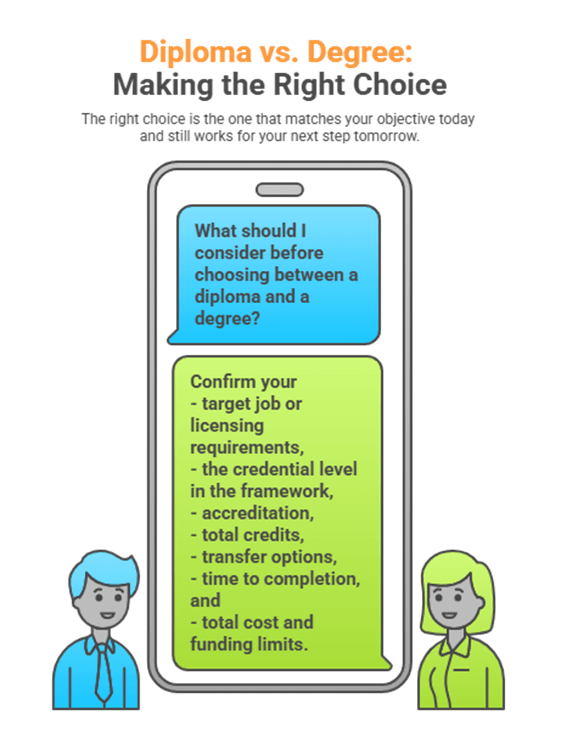
Before deciding, confirm:
- Target job or licensing requirements
- Credential level in the framework
- Accreditation or official recognition
- Total credits and learning outcomes
- Transfer or progression options
- Time to completion
- Total diploma vs degree cost funding limits
Practical next step (recommended)
Shortlist three programs. Also, request written confirmation on:
- Accreditation or framework level
- Eligibility for jobs, licensure, or further study
- Credit transfer or top-up options, if applicable
A diploma can be a smart starting point, and a bachelor’s degree can be a strong long-term investment. The right choice is the one that matches your objective today and still works for your next step tomorrow.

Frequently Asked Questions
Which is better: a diploma or a degree for getting a job?
Neither is universally better. A college diploma can be sufficient for entry-level or skills-focused roles. Whereas a bachelor’s degree is more commonly required for professional progression, leadership roles, or regulated careers. That is why you must always verify job requirements.
How long does a diploma take compared to a degree?
Diplomas have a shorter span. They often range from a few months to two or three years. Whereas degrees have a longer study time. A bachelor’s degree, for instance, is three to four years, depending on the system.
What is the difference between a certificate, diploma and degree?
A certificate is often short yet focused on specific skills. A diploma usually necessitates more structured training. A degree is a more advanced level of study and has well-established career advancement opportunities.
Is a postgraduate diploma the same as a master’s degree?
It is not. A postgraduate diploma is usually completed after a bachelor’s degree but carries fewer academic credits. Also, it does not feature the full research or thesis requirements of a master’s degree.
Can you do a degree after a diploma (credit transfer or top-up)?
In some cases, yes. Many institutions offer credit transfer, bridging programs, or top-up pathways, but acceptance depends on accreditation, credit alignment, residency rules, and institutional policy. Always confirm in writing.
Do employers treat a diploma like a degree?
Employers typically treat them differently. Diplomas may be accepted for certain roles, but degrees are often preferred for advancement, screening systems, or roles with broader responsibility.
How do you check if a diploma or degree is accredited or recognised?
Check the institution as well as program with official accreditation directories or national qualification frameworks, and if you need an international comparison, use the official UK service for comparing international qualifications. Avoid relying on marketing claims or unofficial equivalence statements when choosing between diploma vs degree for jobs.
Conclusion
A degree and a diploma serve different purposes, so you need to know the difference between a diploma and a degree. A degree usually signals a clearly defined higher-education level with broader academic depth and progression options. A college diploma often signals shorter, applied training. But again, its meaning differs widely by country, level and accreditation.
The safest way to choose is to look beyond labels and keep the wider context in mind, including the pros and cons of formal education. Focus on qualification level, recognition, curriculum depth, job or licensing fit, and pathway flexibility. A diploma can be a logical route into work or further study when it is ideally recognised. A degree is often the stronger option for long-term mobility, professional licensing, and graduate education.
Before enrolling, verify accreditation, confirm job or licensing requirements, and get any transfer or progression terms in writing. When you match the credential to your goal and next step, you make a decision that holds value well beyond the classroom.