
What is a CAS Letter? UK Student Visa Guide 2026
What is a CAS Letter? In the UK student visa system, a CAS letter refers to the confirmation of acceptance for studies. It is issued by a UK university or college that holds a valid sponsor licence. This CAS confirms to UK Visas and Immigration (UKVI) that you have accepted an unconditional offer. It also suggests that your institution agrees to sponsor you for study in the UK. Without a valid CAS, you cannot submit a successful UK student visa or student route visa application.
CAS letter meaning in the UK Student visa context
A CAS refers to the confirmation of acceptance for studies. It is a unique reference number issued by a licensed student sponsor. You must include this number when applying for a UK student visa under the student route visa system managed by UK Visas and Immigration (UKVI) and the Home Office. If you’re still planning your journey, see this UK study guide for international students.
In practical terms, the CAS digital record proves three things to the Home Office.
- You have secured a confirmed place on an eligible course.
- Your institution is a licensed student sponsor authorised to recruit international students.
- Your course details, tuition fees and study dates have been formally reported to UKVI.
It is essential to understand that a CAS is not a physical letter. It exists as an electronic record on the UKVI system. Universities usually send a CAS statement by email. It outlines the information held in that record. This includes your CAS reference number.
CAS letter vs offer letter vs CAS statement
- An offer letter confirms that you have been offered a place. It does not allow you to apply for a visa.
- A CAS confirms that you are visa-ready.
- A CAS statement is simply a summary document explaining the CAS record.
“CAS letter” vs CAS number in chemistry
In visa discussions, CAS has no connection to Chemical Abstracts Service numbers. In the UK immigration, CAS always refers to study sponsorship only.

Where the CAS fits in the admissions-to-visa workflow
- Get a conditional or unconditional offer from a UK institution.
- Meet all non-academic and academic requirements.
- Accept and provide the necessary documents.
- Make the tuition deposit, where necessary.
- The university generates a CAS record through the UKVI Sponsorship Management System.
- Get your reference number and statement of CAS.
- Apply for a UK student visa through the CAS.
Before you can receive CAS: Quick checklist
- All offer conditions fulfilled
- Valid passport details provided
- Required tuition deposit paid
- Academic and financial documents verified
- Course start dates confirmed
Once these steps are complete, your CAS becomes the final academic requirement before applying for your UK student visa.
What a CAS statement contains and how to read it
A CAS statement is a structured summary. The UK Visas and Immigration (UKVI) reviews it to assess your UK student visa application. Although students often call it a letter, it is an electronic record. It is linked to your CAS reference number.
Your CAS statement should be carefully read before you apply for your visa. A minor mistake is a setback to an app or even its rejection.
Important areas that you need to check
| CAS field | What it means | What you need to check |
| Title and level of course | Confirms the precise programme that you will be earning | The correct campus or city is provided. |
| Start and finish dates of course | Establishes your course time frame | Dates match your visa application dates. |
| Location of study | Where the course is delivered | Start and finish dates of the course |
| Sponsor name and licence | Identifies the student who has been licensed as a sponsor | University name and sponsor licence are correct. |
| Tuition fees | Total course fees to UKVI | Amount matches your effort. |
| Money received | Payments to the university housing | Recorded if paid through university |
| Accommodation fees | Payments in university accommodations | Only mentioned when paid by the institution. |
| CAS reference number | Uniqueness of your visa application | Recorded if paid through the university |
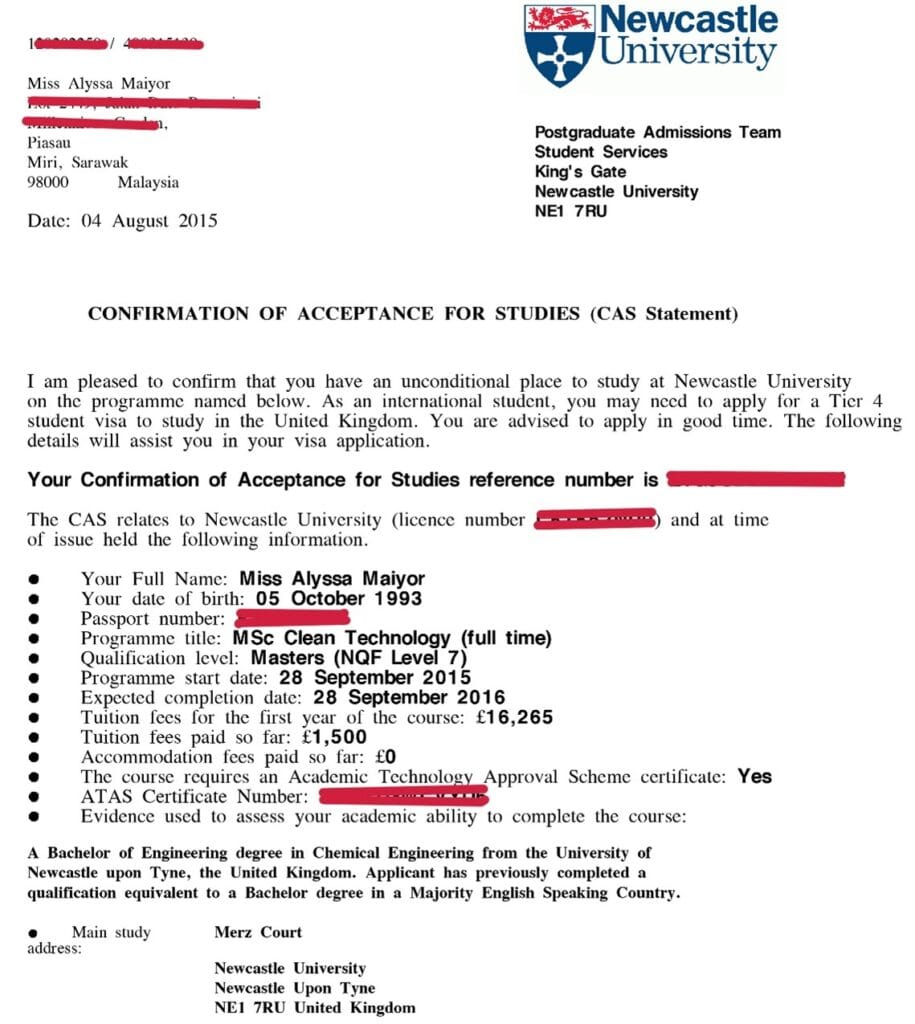
Sample Annotated CAS Statement. An average CAS statement presents the details of the sponsor at the top of the statement, and then comes the course details. It goes as far as to have the breakdown of fees, as well as the payment received. The CAS reference number normally stands out. Never miss a single section when filling out your visa application.
Requirements to obtain a CAS in your university
- Hold an unconditional offer after meeting academic and English language qualifications.
- Provide genuine passport details in an attempt to identify oneself.
- Make the required deposit on tuition, as required.
- Finalise all other requirements, such as ATAS clearance of individual courses.
- Complete the UKVI rules sponsor compliance checks.
- Home Office’s Sponsorship Management System has done the university process verification.
- CAS is issued after all the requirements are done.
Documents usually demanded prior to issuing CAS
- Identity: Checked passport information that reflects on your application perfectly.
- Academic evidence: Transcripts or certificates in case the sponsor anticipates validation.
- English Language proof: IELTS or other similar, where necessary.
- Proof of payment: receipt of tuition deposit or accommodation fees.
- ATAS certificate: Some courses in science and engineering are mandatory.
- Sponsor forms: Questionnaires of compliance or credibility as per the university.
Pre-CAS readiness checklist
- You have unconditional acceptance.
- Your passport information is valid and current.
- The deposits required are paid and registered.
- The evidence of English language proficiency is accepted.
- Any ATAS necessity is fulfilled.
- Sponsor forms are submitted.
These steps come in handy in ensuring your university issues the CAS in time.
How to Get a CAS Letter Step by Step
1. Take up your offer, and accept every condition
Begin by accepting my conditional offer. Thereafter, you need to meet all the academic, English language or credibility requirements. In such a manner, the university will be able to make an unconditional offer.
2. Finish the CAS request checks of the sponsor
The majority of universities require you to fill out an online CAS request/enrolment form. This is the step where the sponsor can check your passport documentation and compliance details.
3. Make deposits and pay fees
Pay any tuition or accommodation deposit requested. These payments often appear on your CAS statement. They may later affect your visa financial calculation.
4. Review your draft CAS carefully
Many sponsors share a draft CAS for approval. Check names, passport numbers, course dates, fees, as well as study location. Ask for corrections immediately if anything looks wrong.
5. Receive your CAS reference number
Once approved, the university issues your CAS reference number electronically. Store it securely. That is because you will enter it directly into your visa application.
Tip: What speeds up or delays CAS issuance
- Complete documents, correct passport details, and early payments speed things up.
- Missing paperwork, name mismatches or late deposits usually cause delays.
A typical timeline runs from several weeks before the course start to CAS issuance. It is then followed by your visa application window.
CAS timing, validity rules, and when you need a new CAS
Questions about timing often come up once students understand what a CAS letter is and are ready to move quickly to the visa stage. Here are some rules to help you avoid costly delays.
Core validity rules you should know
First, a CAS does not last indefinitely. You must submit your UK student visa application within six months of the CAS being issued. This requirement is widely known as the CAS letter validity 6-month rule. If you miss this window, the CAS expires automatically in the UKVI database.
Second, a CAS is usually single use. Once you submit a visa application using a CAS reference number, you cannot reuse it for another application. It doesn’t matter even if you withdraw or make changes later. If you’re unsure about the consequences, read what happens when you withdraw a UK visa application.
Third, some situations require a new CAS. Whereas others do not. This depends on why the original CAS cannot be used and whether your sponsor can still support your application.
When do you need a new CAS?
| Situation | Do you need a new CAS? | What to do next |
| CAS issued less than 6 months ago and has not yet been used | No | Apply for your visa using the existing CAS |
| CAS older than 6 months | Yes | Request a new CAS from your university |
| Visa application refused | Usually yes | Contact your sponsor for refusal review and reissue |
| Course start date changed | Sometimes | Ask the sponsor to confirm if an update or new CAS is required |
| CAS used in a withdrawn application | Yes | Request a fresh CAS reference |
Keeping your information current
Immigration rules can change. Review CAS guidance quarterly for process updates. Prepare for credibility checks by reviewing common UK visa interview questions before you submit. Also, recheck examples and timelines at least once a year on official UKVI pages before applying.

Common CAS problems and fixes
Even when students understand what is a CAS letter, practical issues can still arise between offer acceptance and visa submission. Most problems fall into a few predictable patterns. The key is knowing what you can fix yourself and what only your university, as a licensed student sponsor, can change in the UKVI system.
Troubleshooting by symptom
“My CAS details are wrong.”
Errors in your name, passport number, course title or dates must be corrected before you apply for a UK student visa. Do not submit your application. Contact the admissions or compliance team immediately. Then, request a CAS correction. Only the sponsor can amend the CAS record.
“My payment is not showing on the CAS.”
Payments sometimes take several working days to appear. First, inspect whether the payment deadline has passed. If it has, email proof of payment to the university. Also, ask them to update the CAS statement.
“My course start date changed, or I deferred.”
Deferrals usually require a new CAS. A CAS is linked to a specific course date. So, any major change means the old one may no longer be valid.
“My visa was refused. Can I reuse my CAS?”
In most cases, no. The subsequent CAS is usually issued by the university after examining the cause of refusal and ensuring that it is still sponsored.
Decision logic to keep in mind
Ask one question first. Can the existing CAS still support a fresh visa application? If the answer is uncertain, pause and confirm with your sponsor before proceeding.
Using your CAS in the UK Student visa application
Once you receive your Confirmation of Acceptance for Studies, the final step is using it correctly in your UK student visa form. (If you’re applying from Bangladesh, review the UK student visa rules for Bangladeshi applicants.) This stage matters. Small mistakes here often lead to delays or refusals.
Where you enter the CAS reference number
During the online visa application, you will see a specific section asking for your CAS reference number. Enter it exactly as shown on your CAS statement. Copy and paste if possible. Do not add spaces or extra characters or change the order. UK Visas and Immigration pulls your course and sponsor details directly from this number, so accuracy is essential.
Always double-check that the course title, start date and sponsor name displayed on the form match your CAS. If something looks wrong, stop. Contact your university before submitting.
Documents and evidence commonly tied to CAS
Your CAS connects directly to your financial evidence. Make sure your funds meet the UKVI bank statement format so your documents match what the caseworker expects.
| Evidence type | What UKVI checks | Common mistakes |
| CAS statement | Sponsor, course, dates | Using an expired or incorrect CAS |
| Passport | Identity match | Name mismatch with CAS |
| Tuition fees | Amount paid vs owed | Not accounting for fees already paid |
| Maintenance funds | Living cost threshold | Showing insufficient balance duration |
Visa application pack built around your CAS
Before submitting, make sure you have:
- Valid passport
- CAS reference number from your sponsor
- Financial evidence covering fees and maintenance
- Supporting documents requested by UKVI
A careful final review reduces risk and keeps your application on track.

Frequently Asked Questions
Is a CAS letter a physical document or just a number?
A CAS letter is not a physical document. It is an electronic record held by UKVI. It is shared with you as a CAS reference number and summary statement.
How long does it take to get a CAS letter after accepting an offer?
Most universities issue a CAS within two to six weeks after you accept an unconditional offer and complete deposits, checks and required compliance steps.
How long is a CAS valid, and can it be used more than once?
A CAS is valid for six months from issue. Also, it can only be used once. Once used up, expired or already submitted, you may not utilise it in a subsequent visa application.
Can I apply for a UK student visa without a CAS?
No. A valid CAS reference number from a licensed student sponsor is mandatory. UK Visas and Immigration will automatically refuse applications submitted without one.
What should I do if my CAS has the wrong name, dates, or fee details?
Do not apply for your visa. Contact your university immediately. Then, request a CAS correction. Only the sponsor can amend errors on the UKVI system.
If I defer to the next intake, do I require a new CAS?
Yes, in most cases. A CAS is linked to specific course dates. Deferring usually mandates your university to issue a new CAS reference number.
If my visa is refused, can I reuse the same CAS?
Usually not. Most sponsors issue a new CAS after reviewing refusal reasons and confirming continued sponsorship before you submit a fresh visa application.
Conclusion
A CAS, or Confirmation of Acceptance for Studies, is the sponsor-issued reference. It enables your UK student visa application. Accuracy is crucial in its submission. So, check names and course dates. Also, inspect fees carefully. Align your financial and supporting documents exactly with your CAS statement. That way, you can avoid delays or refusals.
Use the checklists listed in this blog before submitting your visa application. It will ensure a smooth, compliant process. Verifying every detail. Also, follow the sponsor’s instructions. Your simple step can reduce risk and give you confidence that your application meets UK Visas and Immigration (UKVI) requirements.