Taught vs Research Masters: Which Path Suits You?
A taught master’s program delivers a structured learning experience. It does so through regular classes and continuous assessments. In contrast, a research master’s builds around a single, in-depth investigation. And it is shaped by your own questions and supervised academic support.
When students wish to assess how much independence they want or which path aligns better with their long-term goals, they naturally begin comparing the two programmes. This guide breaks down the difference. Let’s learn costs, study patterns and university academic expectations of both.
By the end of this guide, you will have a clear understanding of which route best supports your aspirations.
What is a taught master’s?
A taught master’s falls in the postgraduate taught (PGT) category. It sticks to an organised academic format that can be compared with advanced undergraduate work, but with deeper critical analysis.
You will often see programmes labelled as Master of Science (MSc) or Master of Arts (MA). These degrees are built around timetabled instruction, guided learning and a mixture of modules, credits, lectures, seminars, and supervised projects. To most applicants considering the taught vs research masters, the most distinct aspect is the strong academic guidance offered during the programme.
Students undertake taught modules, then proceed to embark on a dissertation or capstone project. This is a typical route through business, engineering, data science, education and a number of interdisciplinary areas.
Typical structure and learning experience
- Taught masters involve the subject modules which are taught using lectures, seminars, workshops and small group discussions.
- Evaluations are usually in the form of essays, group work, presentations, tests and practical activities.
- Credits are earned each semester until students reach the taught requirement for progression.
- After completion of the taught terms, learners embark on a dissertation period. This is when they put their knowledge into practice under academic supervision.
Common admission requirements
Most universities ask for:
- A recognised bachelor’s degree with suitable grades
- English language proficiency through IELTS or an equivalent test
- Academic transcript and references
- A personal statement
- Work experience or a portfolio for creative or applied subjects
Who usually chooses a taught master’s?
A taught master’s is more appealing to those individuals who favour structured education.
- This is a common path taken by career changers, as it provides a sense of direction and specific skills training.
- Professional employees take it to further their skills in analytics or management.
- This option is ideal for final-year undergraduates who seek greater specialisation before joining full-time work.

What is a research master’s?
A research master’s is a part of the postgraduate research (PGR) category. It is aimed at students who prefer to devote their time to independent research instead of formalised classroom learning. The Master of Research (MRes) and the Master of Philosophy (MPhil) are examples of these degrees. These programmes focus on long-term research, academic investigation and high-level training of methodology.
Students work closely with an academic supervisor. They follow a defined research project and produce a substantial thesis that demonstrates original thought.
Structure, supervision and independence
The research master’s structure revolves around a single major project. Supervisory meetings direct students on the course of action at each step and make sure that ethical and methodological criteria are observed.
Rather than conventional taught modules, students receive intensive research methods training. They even go to seminars or lab groups (as per their field). Also, contact hours in this degree are lower than in taught degrees. That means students manage their schedules with greater independence.
Admissions and research proposals
Universities evaluate the potential of applicants in terms of research. A clear proposal, academic background and compatibility with an appropriate supervisor are necessary. Certain areas need previous exposure to statistics, coding or laboratory methods.
Key documents required are:
- Research proposals with aim, methodology and relevance
- Academic transcripts and references
- CV with any research experience
- English language test results
- Writing samples, when requested
Who usually chooses a research master’s?
- Master’s programmes in research are appealing to future scholars who want to put their idea to the test before committing themselves to a PhD.
- They also attract professionals that desire to have profound subject knowledge in analytical or policy-oriented positions.
How are taught and research master’s different?
The difference between taught vs research master’s is that the former relies on structured modules and coursework, while the latter deals with independent projects supervised by academic staff. Both paths are different in structure, features, contact hours and supervision mode.
Side-by-side comparison at a glance
The following taught vs research masters comparison gives a clear picture into each degree’s core.
| Feature | Taught Master’s (PGT/coursework master’s) | Research Master’s (PGR/MRes/MPhil) |
| Structure | Modules, lectures/seminars/workshops | Independent research project, methods training, seminars |
| Contact hours | High (regular classes) | Low to moderate (occasional supervisor meetings) |
| Assessment | Exams, essays, coursework, sometimes dissertations | Thesis/dissertation, possibly viva voce or thesis defence |
| Dissertation/Thesis weight | Often a smaller portion (project or capstone) | Huge weight, the entire degree built around it |
| Level of independence | Lower; guided timetable and support | High self-directed, self-managed research time |
| Typical duration | 1-2 years full-time (commonly 1 year in the UK) | 1-2 years full-time (often 1 year for MRes; 2 years for MPhil) |
| Common degree titles | MSc, MA, MA/MSc by coursework, coursework master’s | MRes, MPhil, research master’s, MRes/MPhil by research |
| Typical graduate goals | Industry jobs, professional practice, specialist roles | Research careers, PhD preparation and academic or analytical roles. |
Structure, workload and assessment
In a taught coursework master’s, you have a weekly schedule. You attend seminars, workshops or lectures. You do assignments, get feedback, study for exams or deliver group projects. You also complete a dissertation or capstone project under supervision.
This format is appropriate for students who prefer clarity and regular deadlines.
A research master, on the other hand, requires you to plan your time independently. You see your supervisor every now and then to give you directions.
Example weekly time allocation (full‑time)
- Taught Master: 15-20 hours of classes/seminars and 10-15 hours of individual study/assignments.
- Research Master: 5-10 hours of supervisor meetings/seminars and 25-30 hours of independent reading, experiments, data work/writing.
Skills you gain
Listed below are the transferable skills from taught programmes:
- Time management under structured deadlines
- Teamwork and collaboration via group projects
- Generalised knowledge on subjects and multidisciplinary exposure
- Presentation, exam writing, coursework and project-based assessment.
Listed below are the transferable skills from research programmes:
- Independent research design and project management
- Advanced academic writing and data analysis
- Critical thinking and problem-solving in-depth
- Self-motivation, discipline and initiative
Are the fees and funding different?
Cost and funding differ in both types of master’s. Taught master’s, for instance, have a standard tuition and fee model like undergraduate courses. When it comes to research master’s, institutions and funders may offer teaching or research assistantships.

Which type of master’s is right for you?
It is, of course, overwhelming to choose between taught vs research masters at first. Thankfully, here is a section to help you decide based on career goals, learning styles and even finances.
There are students who seek a clear path into the industry. Others want to prepare for a PhD or a role that values research depth. Especially in fields like cybersecurity, where choosing the top destinations for cybersecurity studies can influence long-term career growth. Either way, understanding your needs allows you to choose the right path.
Start with your goal: career, research, or both?
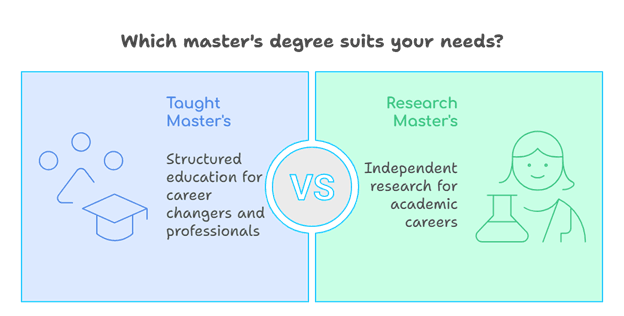
The taught route typically fits students with career objectives or wishing to change careers. It is also suitable for individuals who desire expertise in business, engineering, education, public health, or data-driven areas, including those planning to study cybersecurity in the UK to gain industry-ready technical skills.
A research master is a better fit for anyone who wants to pursue an academic career, work in a research-intensive field or perform policy analysis. It also suits someone who wants to test a PhD concept before investing in a more permanent doctorate.
Match your learning style and personality
Consider the kind of environment that you perform well in. Taught students, for instance, like structure and deadlines. They thrive when teamwork or guided learning is involved.
Research students typically enjoy autonomy and uncertainty. They like deep reading or long-term projects.
Here is a simple way to find your match. If you say YES to most of the following questions, a research master’s is your thing.
- Do you enjoy studying independently?
- Do you like exploring niche questions in-depth?
- Are you excellent at managing time without fixed schedules?
- Do you seek stronger preparation for PhD study?
If you say YES to the following questions, taught masters could be your thing.
- Do you thrive under structured teaching? (Many students pursuing popular IT courses in the UK find that a taught master’s aligns well with their preferred learning style.)
- Are you ready for regular assessment points?
- Do you learn best using modules or via teamwork?
- Are you seeking quick industry relevance?
Practical constraints: time, money, location and visas
Your personal constraints matter too. Taught programmes can be shorter in duration and have more predictable schedules. Research programmes may be lengthy and may include fieldwork or access to a lab, which binds you to a particular place.
Also, take into account your financing sources and possible visa restrictions on part-time or research-based study.
Similarly, any immigration requirements should be verified using official government or university websites. That’s because policies change constantly.
A simple decision framework
Here is a decision framework that will allow you to shortlist programmes and courses.
- Clarify your long-term goals
- Learn the terminology used in your target country
- Shortlist programmes that match your direction. You can explore leading UK universities for master’s study to compare options more effectively.
- Compare the structure, contact hours and fees
- Contact admissions teams or potential supervisors
- Assess your financial and visa requirements
- Set a date and commit confidently

What comes after a master’s degree?
There are a number of avenues that a master’s degree can open. Many graduates choose to progress into a PhD or doctorate. If you are unsure which route fits your goals, you can compare choosing between a PhD and a second master’s to make a more informed decision. Others step directly into professional roles or industry research posts. They even take policy positions or consultancy pathways. You will also come across those who join integrated research programmes that extend off their master’s work.
That is why understanding what route you seek helps you plan early. This is especially true if you are rigorously weighing taught vs research master’s options.
PhD and further academic study
PhD programmes are available to both taught and research graduates. A research master’s, like an MRes or MPhil, can provide more extensive preparation, as it involves a greater amount of independent research time and a larger volume of thesis.
Admissions teams tend to seek good academic grades, a clear, realistic research proposal and good references. They even check evidence of your capability to complete a long-form research project. Some universities also take into consideration previous methods training or any research outputs that you produced during your programme.
Industry and professional careers
A significant number of taught graduates enter the professional world where advanced knowledge and industry-prepared skills are treasured. These positions comprise consultant, data analyst, engineer, education specialist, policy advisor or project manager.
Research graduates join similar positions but usually aim at more analytical-based positions. Examples are industry research scientists, policy analysts or user researchers.
Building a long-term plan during your master’s
Small but consistent steps will help you fortify your future applications. For instance,
- Participate in networking activities and seminars.
- Look for internships or short consultancy projects.
- Join conferences if your field encourages it.
- Build a body of research work, presentations or technical work.
Actions you can take during your master’s to keep your choices open:
- Attend career events and speak with employers early.
- Join academic or professional networks.
- Seek feedback from supervisors or lecturers
- Document achievements and update your CV regularly

Frequently Asked Questions
Can I do a PhD after a taught master’s?
Yes. Taught master’s graduates are permitted to enter PhD programmes in many universities. Good grades, a dedicated proposal and the indication of research capacity are the strengths that enhance your application.
Is a research master’s harder than a taught master’s?
It depends on your strengths. Master’s degrees in research entail independence, self-direction and long-term assignments. Structured learning, continuous assessment and regular deadlines are necessitated by taught master’s programmes.
Do taught master’s degrees still include a dissertation or thesis?
The majority of taught programmes have a dissertation or capstone project. It is generally smaller in size than a full research thesis. However, at the same time, it enables you to practise subject knowledge and build academic skills.
Will a research master’s give me an advantage for academic jobs?
A research master’s can provide better preparation for research-intensive jobs and career trajectories at an early stage. It offers more research preparation and exposure to methods and a large thesis.
How do thesis and non-thesis master’s compare to taught and research masters?
Thesis master’s options are closely related to research programmes. That’s because they emphasise independent study. Non-thesis programmes are taught programmes with coursework and smaller projects.
Can I switch from a taught master’s to a research master’s later on?
Yes, switching is possible in some universities. Typically, you require good performance in school, a supervisor who is ready to help you in your project and a well-defined research proposal.
How should I contact potential supervisors for a research master’s?
Start by reviewing their research interests and recent publications. Send them a brief introduction, your background, what you are proposing and why their expertise is needed. Open communication and concentration of thoughts aid in making a good first impression.
Conclusion
The comparison between taught vs research masters is quite straightforward. Taught master’s degrees offer structured modules and regular assessments. Also, they create clear pathways into professional roles. When it comes to research master’s programmes, the focus lies on independent investigation. You complete a major thesis and prepare for a PhD or research career.
Your decision of degree directly coincides with your goals and learning styles. You need to prioritise practical constraints such as time, funding and location.