Australian Scholarships for Bangladeshi Students 2026
Australian Scholarships for Bangladeshi Students in 2026 include fully funded government awards (especially Australia Awards) and research funding through the Research Training Program (RTP), plus university scholarships for undergraduate, master’s, MBA, and PhD study. The right option depends on your study level, whether you’re applying for coursework or research, and how well your goals match Bangladesh’s priority fields.
Australia offers globally recognised degrees, strong research supervision, and a structured international student system. For Bangladeshi applicants, the biggest challenge is cost: tuition, living expenses, and visa requirements.
This guide covers the core scholarship entities you’ll see across official sources, DFAT Australia Awards, RTP-funded HDR scholarships, university merit awards, OSHC, English tests, and the Student visa (subclass 500) Genuine Student requirement, so you can choose the best pathway and apply confidently.
The main scholarship pathways in Australia
Most scholarship options for Bangladeshi students fall into three practical pathways. Knowing the pathway helps you avoid wasted applications and missed deadlines.
Government-funded, development-focused scholarships
The flagship option is Australia Awards Scholarships, funded by Australia’s Department of Foreign Affairs and Trade (DFAT). These are designed for long-term development impact and leadership outcomes for partner countries, including Bangladesh.
Government-funded research support via universities (RTP)
If you’re applying for a Master’s by Research or PhD (Higher Degree by Research, HDR), most funding runs through the Research Training Program (RTP). RTP is funded by the Australian Government and administered by universities, which select recipients through their scholarship rounds.
University scholarships for coursework, undergraduate, and MBA
For undergraduate, coursework master’s, and MBA programs, funding is usually provided directly by universities and business schools. These awards are often partial (tuition discounts or fixed grants) and may not include living costs.
Australia Awards Scholarships for Bangladeshi students
Australia Awards Scholarships are among the most recognisable fully funded scholarships available to Bangladeshi applicants. They support study at Australian universities and aim to build skills that strengthen Bangladesh’s development outcomes.
What Australia Awards typically cover
Australia Awards commonly include tuition fees, return airfare, an establishment allowance, a living contribution, and Overseas Student Health Cover (OSHC). Exact entitlements can vary by country profile and award conditions, so it helps to compare budget-friendly cities in Australia if you’re planning around living costs and rental pressure.
Priority areas and “Bangladesh alignment”
Australia Awards uses a priority-area approach for Bangladesh, with common focus themes including the blue economy, health, climate and environment, social inclusion, and inclusive economic development (often including ICT and innovation). Your application scores better when your course choice connects to a specific Bangladesh challenge and a realistic return-to-work plan.
Key eligibility entities you must plan for
Eligibility varies by intake, but most applicants should plan around these recurring requirements:
- Citizenship and residency status: applicants must be eligible as Bangladeshi citizens under the Bangladesh program rules.
- Academic performance: a strong bachelor’s record is essential for master’s entry and selection.
- English language tests: universities commonly accept IELTS Academic, TOEFL iBT, or PTE Academic; if you’re leaning toward TOEFL, shortlist universities in Australia that accept TOEFL early so you don’t waste applications on programs that won’t accept your score.
- Return and impact: awards are structured around returning to Bangladesh and contributing after graduation.
When applications open
Bangladesh’s Australia Awards program publishes intake dates on the official country site. For the upcoming cycle, the Bangladesh page indicates applications open on 1 February 2026.
RTP scholarships and HDR funding for Bangladeshi students
If your goal is a funded research degree, RTP-related scholarships are the central entity to understand. RTP funding supports Research Masters and Research Doctorate candidates and is administered through universities rather than direct applications to the government.
What RTP support can include
Depending on your offer and the university’s award type, RTP can include:
- RTP Fees Offset: tuition fee support for HDR candidature
- RTP Stipend: a living allowance paid to the student
- RTP Allowances: support that may include relocation or thesis-related costs, depending on institutional policy
RTP stipend ranges for the current indexed system
The Australian Government indexes RTP base and maximum stipend rates annually and publishes current and recent rates through the Department of Education. Universities typically set stipends within the published range and may add faculty “top-ups” for priority projects.
What makes an HDR application competitive in practice
Bangladeshi students often underestimate how “research fit” works in Australian selection. Competitive HDR applications usually include:
- A focused research proposal with clear methods and a feasible scope
- Evidence of research readiness (thesis work, publications, conference activity, or strong research coursework)
- Early supervisor engagement aligned to a school’s research strengths
- A credible plan for data access, ethics, and timelines within the candidature duration

University scholarships in Australia that Bangladeshi students commonly use
Australian universities offer a mix of scholarships that behave differently. Understanding the “type” is more useful than memorising hundreds of names.
Merit scholarships for coursework and undergraduate study
These are often automatic or semi-automatic based on grades. They typically reduce tuition (percentage discount or fixed amount) and may be renewable if you maintain academic progress. They rarely cover living expenses.
Faculty and business school scholarships (including MBA)
Business schools often award scholarships for leadership and impact, not just grades. MBA scholarships commonly require evidence of professional achievement, leadership, and strong career goals.
University HDR scholarships (often RTP-aligned)
These include RTP-funded awards and university-funded research scholarships. They usually cover tuition and include a stipend, especially for top-ranked HDR candidates in competitive rounds.
Visa, compliance, and essential application entities
Even a strong scholarship offer can fail if you don’t meet visa and compliance requirements. These entities matter for nearly every Bangladeshi applicant.
Student visa (subclass 500) and the Genuine Student requirement
Australia’s Student visa (subclass 500) uses a Genuine Student (GS) requirement for applications lodged on and after 23 March 2024, replacing the earlier Genuine Temporary Entrant (GTE) requirement. Plan your GS responses carefully and keep your study goals consistent with your academic and career history.
OSHC (Overseas Student Health Cover)
OSHC is mandatory for most international students on a student visa. Many fully funded scholarships include OSHC; university scholarship packages vary, so confirm whether OSHC is covered or reimbursed.
English tests and score validity
Most Australian institutions accept IELTS Academic, TOEFL iBT, or PTE Academic. Use the test accepted by your target university and ensure your scores remain valid for the intake and scholarship timeline.
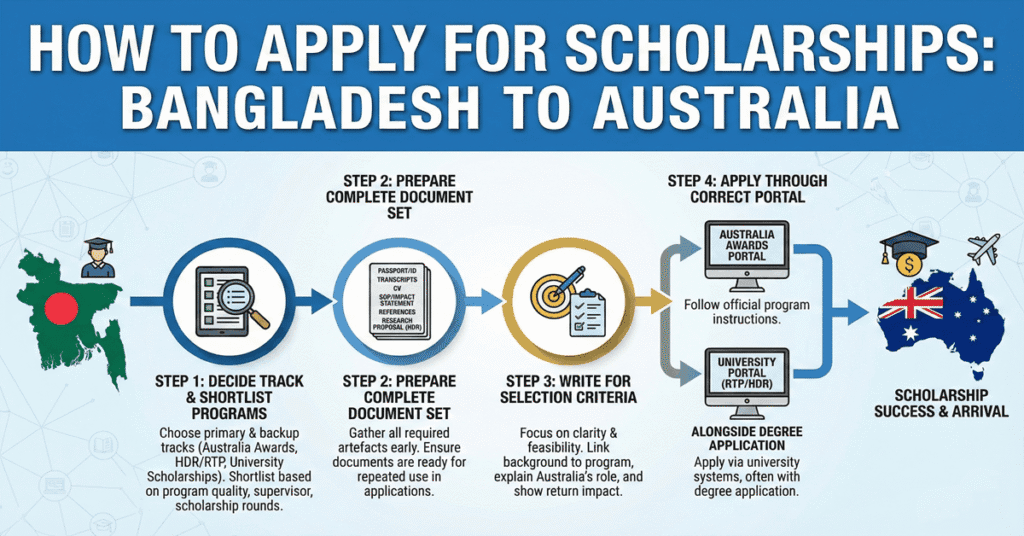
How to apply for scholarships from Bangladesh to Australia
A scholarship-winning application is built around evidence, fit, and timing, not hype. Start early enough that you can revise documents and secure references.
Step 1: Decide your track and shortlist programs
Choose one primary track (Australia Awards, HDR/RTP, or coursework/university scholarships) and one backup track. Shortlist universities based on program quality, supervisor availability (for HDR), and scholarship rounds. If your plan includes work experience after finishing your degree, map the rules for post-study work options in Australia before you lock your course and location.
Step 2: Prepare a complete document set
Most scholarship systems repeatedly ask for the same artefacts:
- Passport and identity documents
- Academic transcripts and certificates
- CV with measurable outcomes
- Statement of purpose (or development impact statement)
- References or referee reports
- For HDR: research proposal and supervisor correspondence where required
Step 3: Write for selection criteria, not inspiration
Selection panels usually reward clarity and feasibility. A strong statement links your background to your chosen program, explains why Australia is the right training environment, and shows what changes after you return to Bangladesh.
Step 4: Apply through the correct portal
Australia Awards uses official program instructions and country guidance. RTP and HDR scholarships are applied for through the university, often alongside the research degree application.

Frequently Asked Questions
Can I apply for multiple Australian scholarships at the same time?
Yes. Many applicants apply for university scholarships while also applying for Australia Awards (if eligible). Keep your course choice and goals consistent across applications.
Are Australia Awards available for undergraduate study from Bangladesh?
Australia Awards in Bangladesh is primarily framed around scholarship outcomes that align with Bangladesh program priorities and published intake guidance. For undergraduate funding, university merit scholarships are usually the main route.
Do I need a supervisor before applying for an RTP-funded PhD?
Many universities strongly prefer supervisor engagement for HDR applications, especially for competitive scholarship rounds. Early supervisor alignment often improves your chances.
What’s the difference between an RTP stipend and a fees offset?
A fees offset supports tuition costs for HDR study. A stipend supports living costs. Some offers include both, and some include allowances as well.
Is OSHC always included in scholarships?
Not always. Australia Awards commonly include OSHC, while university scholarships vary by award conditions. Always confirm in your offer letter or conditions.
Does Australia still require GTE for the student visa?
For applications lodged on and after 23 March 2024, the requirement is Genuine Student (GS) rather than GTE for the Student visa (subclass 500).
How early should I start preparing?
For fully funded and HDR scholarships, start 8–12 months ahead: test preparation, document collection, supervisor outreach, and multiple drafts of your statement and proposal.
Conclusion
Australian Scholarships for Bangladeshi Students in 2026 are best approached as a system: DFAT Australia Awards for development-focused master’s study, RTP and university HDR scholarships for research degrees, and university merit awards for undergraduate, coursework master’s, and MBA programs. If you align your field to Bangladesh priorities, prepare GS-ready visa documentation, and submit evidence-driven applications, you’ll compete far more effectively.