
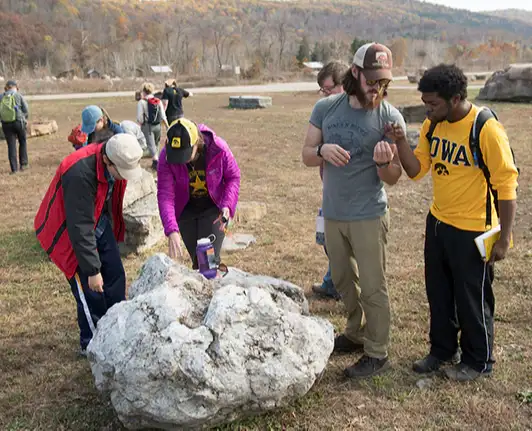
This course aims to cover many topics which examine the geological and geophysical aspects of the Earth, its structure, formation, composition, history, processes, resources, hazards, and materials. It aims to look at rocks, minerals, and fossils, how they were formed, how they are found and exploited sustainably as a resource, and what they tell us about the history of the Earth. It also covers geological and geophysical processes such as earthquakes, volcanoes, and plate tectonics. Geophysics is a practical subject with applied problem-solving laboratory classes and field courses where you will learn how to collect, process, and interpret geophysical data, and explore future geological resources. This course aims to focus particularly on applied geophysical research skills and you will learn to carry out your own research using specialist geophysical software and equipment. Furthermore, you will complete a comprehensive and integrated fieldwork program.
BSc (Hons) Geology (Applied Geophysics)
Modules
Year 1
- Minerals and Rocks
- Earth Structure
- Academic, Professional, and Fieldwork Skills
- Geoscience Data Interpretation, Analysis, and Visualisation
- The Earth System
- Climate Change: The Scientific and Societal Context
- Stratigraphy and Palaeontology
Year 2
- Igneous and Metamorphic Petrology
- Palaeoclimatology and Quaternary Studies
- Employability Training: Engaging with the Workplace
- Field Skills
- Reconstructing Past Environments
- Near-Surface Geophysics
- Geoscience and Society
Year 3
- Applied Geophysics – Independent Project
- Exploration Geophysics for the Hydrocarbon Industry
- Frontiers in Applied Geophysics
- Hydrological and Engineering Geology
Optional Modules
- Natural Hazards
- Economic Geology
- Advanced Topics in Sedimentology
- Structure and Geodynamics
- Water Resources
- The Science of Soil
Employability
You will acquire a wide range of transferable skills, including communication, decision-making, and problem-solving skills, and the ability to research, evaluate and synthesize information from diverse sources. You will develop subject-specific skills like the ability to manipulate, analyze and present geophysical data using industry-standard software. You might choose to work in geophysical, geological, or environmental consultancy, in construction, mining, in the energy sector, planning, or insurance.
Jobs that a graduate of this course could go on to do:
- Exploration Geologist
- Geological Engineer
- Geoenvironmental Engineer
- Survey Geologist
- Geophysicist
- Volcanologist Geotechnical Engineer
- Hydrogeologist
Key Facts
Requirements
- A-LEVEL REQUIREMENTS- BBC
- English Language/Literature at C (or 4) OR equivalent qualification
- BTEC-DMM
- INTERNATIONAL BACCALAUREATE- 29 points
Duration options
Full-time, 3/4 years
Fees and Applying
EU/Home – Tuition Fees:
- Full-time: £9,250 UK
International –
- Tuition Fees: £15,500


